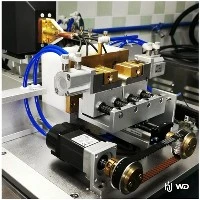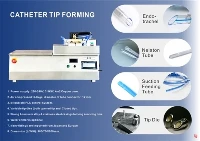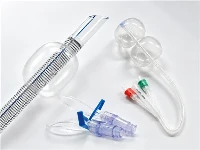

High frequency tip forming machine is a specialized manufacturing equipment that commonly used in the production of medical catheters, cannula, dilators, and etc. The machine forms smooth, rounded, sealed, beveled, or customized distal ends through thermal processing, ensuring safety and comfort in medical applications.
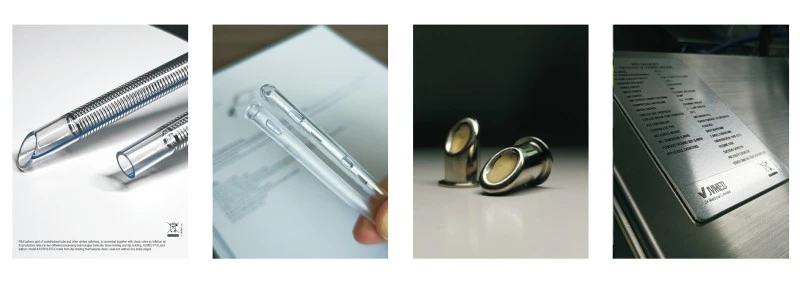
Compatible Tubes:
Tip forming machine is suitable for a wide range of thermoplastic tubeing, including:
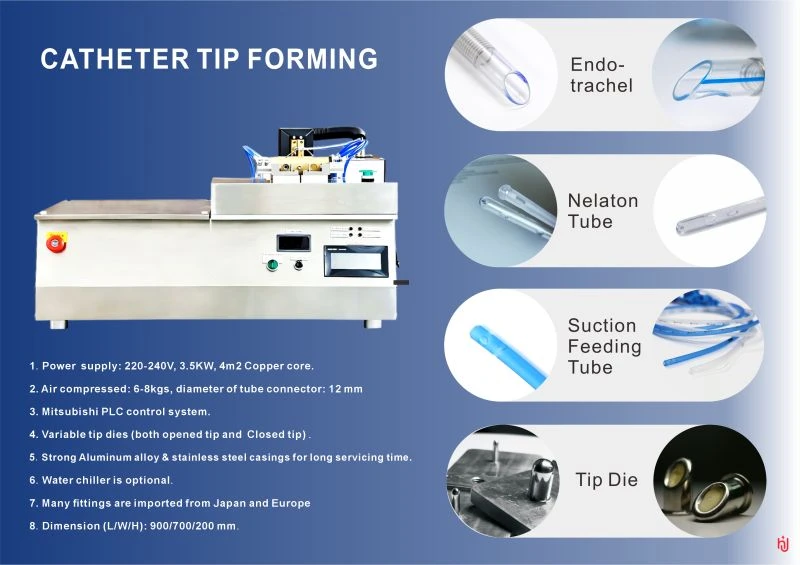
Endotracheal tube, suction catheter, nelaton catheter, feeding tube and other similar catheters. The machine remains the same across the above catheter types providing controlled heating, cooling, and motion. What matters most is the tipping die. Each die is tailored to the tube's exact specifications-including OD, ID, wall thickness, tipping length, material characteristics, and target profile. With the right machine settings and correctly matched die tooling, manufacturers can achieve a reliable tip quality and stable production.
Main Features of the Tipping Machine:
- Production capacity: 1,500 pcs per hour (ETT).
- Power supply: 220-240V, 3.5KW, 4m2 Copper core.
- Air compressed: 6-8kgs, diameter of tube connector: 12 mm.
- Mitsubishi PLC control system.
- Many fittings are imported from Japan and Europe.
- Strong Aluminum alloy & stainless steel casings for long servicing time.
- Can be used for tube forming processing of endotracheal tube, feeding tube, sputum aspiration tube and foley catheter tube etc.
- Dimension (L/W/H): 900/700/200 mm.
Notes:
- Tip dies (both opened tip and closed tip) are optional.
- Water chiller is optional.
- Other machines for tubes/catheters cutting, notching, printing and cuff bonding etc are optional
Tipping Machine Working Process
- The melt tip forming process is straightforward, but each stage must be controlled accurately to achieve a stable result.
- Tube loading and positioning - consistent positioning into the fixture and aligned to a precise insertion depth is critical.
- Heating and tip forming - once the material reaches the proper forming condition, the tipping die shapes the tube end into the required profile,
- Cold water cooling - cold water in the chiller is circulated through the die to stabilize the tip shape
- Fixture opening and tube removal
- Inspection - inspect for tip shape, dimensions, surface smoothness, and overall appearance.
The entire cycle - from tube loading to tube removal - typically runs between 10 and 30 seconds, depending on tube type, wall thickness, material, and tip geometry.
A great tip forming comes down to three things: the machine itself, the die, and a clear understanding of your tube material and application. When these three factors work in alignment, requirements for both functional and patient-comfort can be consistently achieved.
2026-09-24丨MFG WISE丨by Celia Xie